ATSC 113 Weather for Sailing, Flying & Snow Sports
Right-side Up and Upside Down Snow
Learning goal 7c: Describe right-side-up and upside-down snowfall and their significance to skiing and avalanches
In Learning Goal 7b we discuss the factors influencing the density of newly-fallen snow. Snow density matters because it affects avalanche danger and ski quality. Here we talk about what happens when the density of falling snow changes over the course of a storm.
Right-side-up snow
Right-side-up snow has higher-density (heavier) snow underlying lower-density (lighter) snow. This typically occurs when temperature and/or wind speed decreases during the course of a storm or storm cycle. A storm cycle is simply a series of storms in quick succession, with short breaks (day or less) or no breaks in between.
A change in temperature and/or wind during the course of a storm will affect the density of the newly-fallen snow. A typical right-side-up storm would be cold-front dominated. That is, most of the snow occurs with and following the cold front. Since temperatures decrease following a cold front, the newly-falling snow would decrease in density as the storm passes, leading to a right-side-up new snow layer.
Often it is also windiest near the cold front, becoming less windy following the front. In this case the temperature and wind effects on density are working in concert to deliver a right-side-up new snow layer.
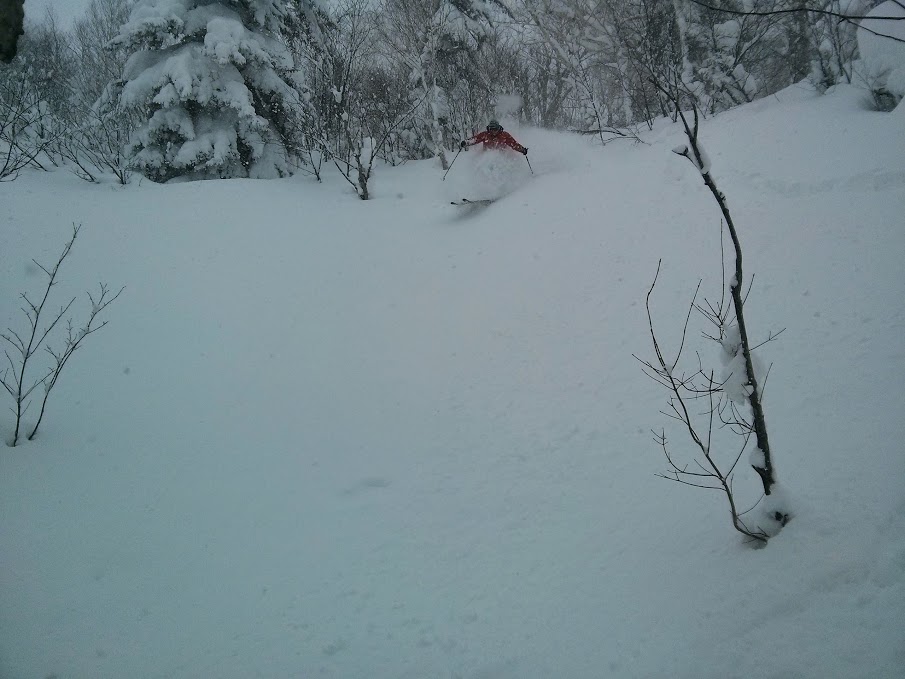
Fig. 7c.1 - Right-side-up new snow in Niseko, Japan. Right-side-up snow tends to feel bouncier and floatier to ski in. If it's deep enough, the low-density snow on top often sprays and billows up around you. (Credit: West)
Right-side-up snow is good for skiing because the vertical density gradient has a tendency to lift your skis or snowboard. It's more bouncy and floaty to ski in. Since it lifts your skis or board so easily, it's relatively easy to ski in. It's also a ton of fun!
The benefits don't end there. Recall from Learning Goal 7f that higher-density snow underneath lower-density snow is a stable configuration of snow layers. So, right-side-up new snow layers tend to be more stable, and thus less prone to storm-snow avalanches.
Upside-down snow
Upside-down snow in the snowpack is, as you might guess, the opposite: higher-density snow overlying lower-density snow. This typically occurs with a warm front (you will learn more about these in the next module). Temperatures increase following a warm front, leading to increasing newly-fallen snow density with time. Upside-down snow can also occur if it gets windy towards the end of a storm.
For new snowfall within a storm cycle, you only need to consider density changes within the most recent ~24 hours. Snowfall density changes prior to that will have been largely eliminated by settling within the snowpack. Don't forget that persistent weak layers (e.g., surface hoar) can linger for months within the snowpack.
Upside-down snow is difficult to ski. Your ski tips want to dive down under the snow. It can be hard to keep them above the surface. Snowboarders have the advantage here; they will be able to more easily float and bust through this stuff. Skiers with fat skis will fare far better than those without. Telemarkers, however, typically suffer the most in these conditions. It's on these days that they can be seen faceplanting and cursing (they too may end up "upside-down") while snowboarders blast by them with a smile on their face.
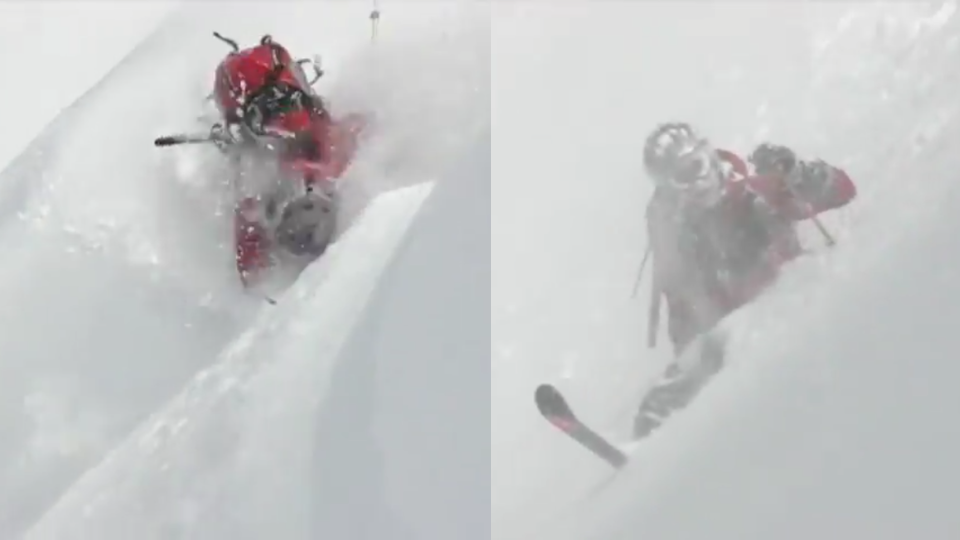
Fig. 7c.2 - "During" and "after" shots of a telemark skier faceplanting into a somersault in upside-down snow, in the Wasatch Mountains of Utah, USA. (Credit: West)
Upside-down snow also makes for bad avalanche conditions. Remember that higher-density snow overlying lower-density snow is an unstable configuration. Thus, when you have newly-fallen snow that's upside-down, you're more likely to have problems with storm-snow avalanches.
It is possible for the temperature and wind speed effects to counteract each other. For example, you may have a storm with decreasing temperatures, so the snow that's falling is decreasing in density. However, towards the end of the storm the wind increases. A fast enough wind speed could overcome the density-lowering effects of cooling temperatures.
This could yield a new snow layer that is right-side-up in the lower part (due to decreasing temperatures), but then becomes upside down towards the top (due to winds). Remember, however, that you only need one unstable layer somewhere in the snowpack for the whole snowpack to be unstable.
The right tool for the job
Snowboarders have a definite advantage in high-density and upside-down snow; having 2 legs controlling one board is easier than 1 leg per board (skis). Snowboards tend to both power through snow and float more readily. I know people that ski, telemark, and snowboard, and when the new-snow is going to be difficult to make turns in, their snowboard is the weapon of choice. Choosing the right tool for difficult or deep snow, whether it be fat skis or a snowboard, can make the difference between having a frustrating, unenjoyable day and an awesome powder day.
Story time:
Back when I lived in Utah, most storms were right-side up. After moving here to the south coast of BC, I found the snow quality to be far less consistent. Storms more frequently featured higher-density, and upside-down new snow. In Utah I telemarked 95% of the time, and skied AT skis about 5% of the time. It didn't take long after I moved here to become 95% AT skis, and 5% telemark. Ultimately, you want to be riding down the hill on whatever you're going to have the most fun on.
Keywords: stable, storm cycle, storm-snow avalanche, unstable
Figure Credits
Stull: Roland Stull
West: Greg West
Howard: Rosie Howard
COMET/UCAR: The source of this material is
the
COMET® Website at http://meted.ucar.edu/ of the University Corporation
for Atmospheric Research (UCAR), sponsored in part through cooperative
agreement(s) with the National Oceanic and Atmospheric Administration
(NOAA), U.S. Department of Commerce (DOC). ©1997-2016 University
Corporation for Atmospheric Research. All Rights Reserved.
Google: Map data (c) 2016 Google.