News
Stay up-to-date with what's happening in EOAS
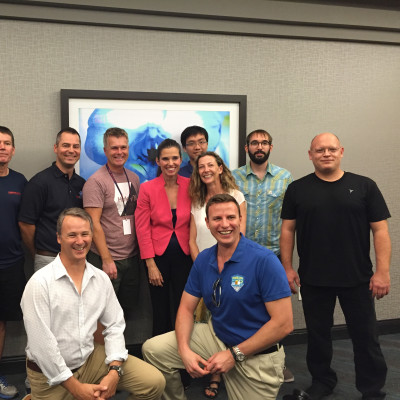
Catherine Johnson lends expertise to asteroid sampling mission OSIRIS-REx
UBC planetary geophysicist Catherine Johnson is watching today’s launch of NASA's OSIRIS-Rex mission with more than a passing interest.
The Canadian Space Agency’s contribution to the mission is the OSIRIS-Rex Laser Altimeter (OLA), an instrument designed to map the shape of the asteroid Bennu. Johnson is deputy instrument scientist for OLA, assisted by UBC Earth, Ocean and Atmospheric Sciences colleagues Lydia Philpott and Manar Al Asad.
“OLA will map the asteroid shape in unprecedented detail, down to a resolution of a few centimeters,” says Johnson. “This is a first for asteroid studies and will provide insights into the interior structure and origin of the asteroid, as well as help OSIRIS-REx successfully return a sample from the surface.”
Johnson will collaborate with an international science team on OLA, including lead instrument scientist Michael Daly at York University and colleagues at the University of Calgary, Johns Hopkins University Applied Physics Laboratory, Lockheed Martin Space Systems, MacDonald, Dettwiler and Associates, and Optech.
OSIRIS-REx will map and subsequently sample Bennu. The carbonaceous asteroid is leftover material from our protoplanetary disk, the cloud of gas and dust leftover from the Sun’s formation that collapsed to form the Solar System. The asteroid’s material remains relatively untouched since that event 4.5 billion years ago. Scientists intend to use samples of the asteroid to better understand the origins of our Solar System and the chemical precursors to life on Earth.
As it approaches Bennu in August of 2018, it will use a set of precise thrusters to match the asteroid’s orbit around the sun. OSIRIS-REx will map Bennu’s shape, topography and surface features for over a year. OLA collects data by emitting laser pulses and timing how long the light takes to return to its sensors after reflecting off the asteroid’s surfaces.
The topographic information collected by OLA, together with other physical and chemical data collected from OSIRIS-Rex’s four other imaging instruments, will be used to select a location on the asteroid from which to sample material. In a delicate maneuver, OSIRIS-REx will extend an arm to touch the asteroid’s surface, collecting at least 60 g of material in a few seconds of contact. OSIRIX-REx will return home with the sample to Earth in 2023.
Related Links
Doug Oldenburg has been elected to fellowship in the Royal Society of Canada
The citation from the RSC website reads: OLDENBURG, Douglas W. - Department of Earth, Ocean and Atmospheric Sciences, The University of British Columbia Douglas W. Oldenburg is the world's leading developer of geophysical inversion methods and software for quantitative interpretation of geophysical data acquired by the mineral industry and others to explore Earth's shallow subsurface. The research by him and his co-workers has set the standard by which all similar developments are judged. His software is used by hundreds of scientists in industry and academia.
2013 John A. Franklin Award - Erik Eberhardt
Bi-annual award by the Canadian Geotechnical Society recognizing an individual who has made outstanding technical contributions in the fields of rock mechanics or rock engineering applied to civil, mining or petroleum engineering in Canada and/or internationally.
2014 Canadian Geotechnical Colloquium - Scott McDougall
The Canadian Geotechnical Colloquium prize involves the selection of a young (under 40) engineer who shows top promise in their professional or academic career, to present a state-of-the-art colloquium address at the annual Canadian Geotechnical Conference.
Student Awards
Second place, 2013 Canadian Geotechnical Society's Student Competition Undergraduate Report Award - Jenna Bowling, Ryun Humenjuk, Crystal Lei, Adam Woods, Xiao Qin Yang. EOSC 445 (Engineering Design Project): "Foundation and West Approach Embankment Design of the New Fraser River Crossing".Nicole Eriks - 4th-year Geology Major Student;Nicole has been awarded the Mineralogical Association of Canada "Distinguished 2012-2013 Undergraduate Student Awardee" for demonstrated academic excellence in Mineralogy, Crystallography, Petrology, Geochemistry and Economic Geology at the University of British Columbia.
Kathi Unglert is one of 26 UBC graduate students to receive a 2013 Vanier Fellowship
Kathi's fellowship supports work that builds understanding of the character and mechanics of seismic tremors that occur before and during volcanic eruptions. A principal motivation of her project is to provide a reliable way to use the emergence and evolution of various tremor properties to inform eruption forecasting models. Congratulations Kathi! For more information about the Vanier program: http://news.ubc.ca/2013/10/03/young-researchers-receive-4-8-million-boo…