


NEWS SPOTLIGHT

This summer, EOAS Professor Rich Pawlowicz and PhD student Missy Westland joined a six-week research expedition aboard the Swedish icebreaker Oden. Travelling through the central Arctic Ocean to the North Pole, they joined researchers and students from Canadian and Swedish universities to study one of the most rapidly changing environments on Earth. The expedition ran alongside a Canada–Sweden seabed-mapping program involving the Canadian icebreaker Louis S. St-Laurent.
Alongside its scientific investigations, the expedition hosted an international research school covering six topics: marine geology, geophysical mapping, meteorology and aerosols, sea ice properties, oceanography and marine chemistry, and primary productivity and biogeochemistry. It also hosted programs for teachers and artists. Together, these research areas aim to improve our understanding of the interactions between the Arctic Ocean, atmosphere, sea ice, and marine ecosystems.
Pawlowicz led the physical oceanography field school, conducting measurements of double diffusion, underwater ambient noise, large-scale circulation, and more. On one occasion, he deployed an expendable conductivity-temperature-depth (XCTD) probe simultaneously with an atmospheric weather balloon, collecting measurements extending from the deep ocean to the stratosphere.
“I couldn’t believe it, everything worked!” shared Pawlowicz, adding that he is looking forward to digging into the data now that he is back on land. He is particularly interested in studying turbulence associated with double-diffusive staircases, which form when differences in temperature and salinity create distinct layers within the ocean. For Pawlowicz, who had previously studied these structures in Powell Lake, British Columbia, the expedition offered a unique opportunity to investigate them in the Arctic Ocean.

Student launching a weather balloon from the deck of the Oden. (https://www.su.se/english/divisions/department-of-meteorology/news/articles/2026-08-14-expedition-arctic-ocean-2026-blog-post-2-balloons)
Westland participated in the meteorology and aerosols research group, which investigated atmospheric conditions over the Arctic Ocean. The group launched weather balloons every six hours to measure temperature, wind speed, and wind direction throughout the atmosphere. These observations supported short-term weather forecasts aboard Oden and contributed to international meteorological datasets. The group also used lidar measurements taken from the ship to improve measurements of sea-ice surface roughness.
Scientific work also took researchers beyond the ship, with some teams using helicopters to access ice floes for field measurements. Polar bears added a unique aspect to off-ship research: although the bears were exciting to spot from the ship, their presence required careful checks of the ice before helicopters could land. Another highlight was reaching the geographic North Pole, where everyone disembarked from Oden for a group photograph—a particularly special moment for those visiting the Arctic for the first time.

Group photo at the North Pole in front of the icebreaker Oden. Photo: Andreas Norman (https://www.polar.se/en/news/2026/north-pole-day-on-16-august/)
The expedition provided opportunities to observe changing Arctic conditions. Researchers encountered extensive areas of open water within the sea ice, observed new ice forming as temperatures fell, and experienced the transition from continuous summer daylight to the first sunset on September 15.
The expedition concluded in September, providing new observations of Arctic Ocean and atmospheric conditions while offering participants practical experience in polar research. Both Pawlowicz and Westland described the expedition as a valuable research and learning experience and strongly encourage students interested in Arctic science to apply for future research schools!
Read the meteorology and aerosols group’s trip blog here: https://www.su.se/english/divisions/department-of-meteorology/research/conferences-and-seminars/the-ao26-blog-the-expedition-arctic-ocean-2026
Read the Swedish Polar Research Secretariat blog here: https://www.polar.se/en/news/?c=Blog%20posts&t=Canada-Sweden%20Arctic%20Ocean%202026

Applications for the 2026/27 Climate Studies IBPOC Student Support Fund are now open, with $2,000 in total funding available.
Established jointly by UBC’s Departments of Geography and Earth, Ocean and Atmospheric Sciences (EOAS), the fund provides support to undergraduate students from Indigenous, Black, and other racialized communities of colour who are studying climate change at UBC. The fund operates in the spirit of repair – to recognize and help address the inequities that IBPOC students face, and the underrepresentation of IBPOC people in climate research in Canada, acknowledging the vital perspectives they bring to understanding and addressing the climate emergency.
Preference will be given to students enrolled in the Certificate in Climate Studies and Action program, but students in other programs are also encouraged to apply.
The deadline to apply is November 1st, 2026.
Learn about the fund and application process: Climate Studies IBPOC Student Support Fund
Apply here: Application form
If you have any questions, please contact climate.certificate@ubc.ca

Five EOAS researchers are among the recipients of the 2026 Wall Research Awards, with projects spanning forest hydrology, climate and energy systems, sustainable agriculture, biological oceanography and marine virology, reflecting the breadth of research across the department.
The Wall Research Awards are part of the Peter Wall Legacy Awards, supported by the groundbreaking $150 million+ Peter Wall Legacy Fund. Together with the Wall Fellowships, they form one of the largest internal award programs at any university in North America, providing approximately $4 million annually to support UBC research. The awards focus on research relating to British Columbia in three broad areas: sustainable urban development; environmental protection of oceans, beaches and waterfronts; and sustainable approaches to resource-intensive industry.
($80,000 for individual UBC faculty members to be spent within a three-year term)
Dr. Ali Ameli (Associate Professor) was recognized with an Individual Faculty Award for From Forest Ruts to Streams: How Forestry Machinery Alters Water and Solute Pathways and Connectivity.
Forestry machinery can leave behind ruts, tracks, and compacted soils that alter how rainfall and snowmelt move through forests and reach streams, yet these impacts remain poorly understood. This research will examine forested landscapes across British Columbia, using advanced modelling to understand how machinery-related disturbances affect water movement and stream connectivity under current and future climate conditions. In partnership with regional offices of the B.C. Ministry of Forests, the project will translate these findings into practical guidance for forestry operations to help protect water resources in actively managed forests and surrounding communities.
($200,000 for groups of 3-5 UBC faculty members to be spent within a three-year term)
Dr. Valentina Radic (Professor) is part of the team awarded for Climate Change and its Impact on B.C.’s Electricity Generation: AI Driven Climate and Grid Planning.
British Columbia relies on hydropower for clean electricity, but climate change is altering snowpack and water flows, making energy supply less predictable as demand grows from population growth, electric vehicles, and heating. This research will use climate data, water system modelling, and advanced energy system analysis to understand future impacts on B.C.’s electricity system and identify solutions, including renewable energy and storage options. The findings will support long-term planning for a reliable, resilient and sustainable electricity system in the face of a changing climate.
Dr. Mark Johnson (Professor) is a member of the team behind From Field to Supply Chain: A Multi-Indicator Sustainability Benchmarking Framework for British Columbia Farms.
B.C. farmers face growing demands from buyers, certifiers, and policymakers to demonstrate sustainability across areas such as greenhouse gas emissions, soil health, biodiversity, and farming practices, yet no single tool helps them measure progress across these areas. Building on LiteFarm, UBC’s globally used farm management application, this research will create a free, bilingual, privacy-protected sustainability benchmarking tool that helps farms respond to diverse supply chain requirements through a unified approach. Co-designed with B.C. and global farming communities, including small-scale and Indigenous producers, the platform will support sustainable agriculture, inform policy, and strengthen climate and biodiversity efforts across the province.
($30,000 per year for PhD candidates for one or two years and at $25,000 for Master’s students for one year).
Bronwyn Hobson (Master of Science in Oceanography) was selected for a Graduate Student Award for Bloom or Bust: How local processes influence phytoplankton in Barkley Sound, British Columbia.
Her research focuses on the conditions that influence phytoplankton in Barkley Sound, British Columbia. Phytoplankton, or microscopic marine algae, form the base of ocean food webs. Their seasonal blooms provide a critical food source for many important species in British Columbia, such as salmon. However, bloom timing and size can vary, and short-term extreme events like marine heatwaves can disrupt healthy bloom conditions. Most current monitoring focuses on large ocean regions, missing important small-scale processes that influence phytoplankton growth—such as tides and daily wind patterns. My research uses high-resolution ocean measurements to explore how local processes impact coastal phytoplankton.
Allie Roberts-Moore (Doctor of Philosophy in Oceanography) received a Graduate Student Award for Characterizing the viruses of copepods and larval Dungeness crab in British Columbia.
Her research identifies, studies, and monitors viruses of copepods and larval Dungeness crab, planktonic animals that are integral to B.C. marine food webs and fisheries. The viruses that infect these organisms and their effects on host populations remain poorly understood, with Fisheries and Oceans Canada (DFO) identifying a specific knowledge gap in Dungeness crab larval biology. B.C. fishers and conservation bodies rely on accurate biological information, including knowledge of pathogens, to support healthy fisheries and ecosystems. My research will strengthen pathogen surveillance and contribute to understanding the life cycles of organisms key to B.C.’s coastal economy.
Full list of Wall Legacy Award recipients, with a description of their projects: https://walllegacyawards.ubc.ca/awardees-2026/

Written in collaboration with Dr. Ali Ameli
Most of the world’s flowing waters remain unmeasured, posing one of the biggest challenges to water security worldwide. This lack of data makes it difficult to forecast floods, protect water quality and sustain aquatic ecosystems. A new study led by UBC researchers establishes the first globally scalable framework for the functional classification of catchments, grouping them by how consistently rainfall is converted into runoff.
Published in Nature Water, the study mapped how rainfall becomes streamflow–the movement of water from the land to water bodies–across more than 80,000 catchments–areas of land where rainfall and other water drain into a common outlet. The research was led by Dr. Ali Ameli, Associate Professor in UBC’s Department of Earth, Ocean and Atmospheric Sciences, with Hamed Sharif, Researcher in the department, and Dr. Jeffrey McDonnell, Professor at the University of Saskatchewan and the University of Birmingham.
The global picture was striking. “For most of the planet, knowing how much rain fell tells you surprisingly little about how much water will reach the river,” said Dr. Ameli. Catchments classified as functionally “complex” drain 87% of the ungauged land area assessed in the study, some 121 million of 139 million km². In these catchments, the same amount of rain can produce very different amounts of streamflow from one storm to the next, making river responses to storms difficult to anticipate.
Western British Columbia, however, stands out as one of the clearest exceptions to this complex global pattern. Along BC’s steep, wet Coast Mountains, the researchers found a broad band of catchments that behave much more consistently: the amount of rain falling during a storm is closely related to the amount of runoff reaching the river. These catchments were classified as functionally “simple”. “This consistency is rare globally and was one of the most striking surprises of the study,” said Dr. Ameli.
Why these catchments behave so consistently comes down to the rhythm of their rainfall. Across the study, the strongest single discriminator between the functional types was rainfall persistence, the fraction of each season carrying non-negligible rain. Simple catchments receive rain frequently and stay persistently wet, so successive storms meet similar antecedent conditions. Complex catchments receive rain only intermittently and swing between wet and dry states.

Two catchments at opposite ends of the classification. Left: the Rio Itapecuru at Rosário, in Maranhão, northern Brazil. The catchment is classified as complex; its mean slope is about 3 degrees with no persistent rainfall falls in the dormant season. Credit: Johan Fredriksson, CC BY-SA, via Wikimedia Commons. Right: Barkley Sound near Bamfield, on the west coast of Vancouver Island, within the broad band of simple catchments identified along the Coast Mountains. The catchment here has a mean slope of about 21 degrees, and receives non-negligible rain in every week of the dormant (non-growing) season. Credit: UBC.
By classifying and locating these different functional types of catchments, the study provides a global blueprint for prioritizing streamflow monitoring and selecting flood and water-resource models. Relatively simple catchments may not require highly complex models, whereas the complex catchments that dominate much of the world require models capable of representing changing hydrologic behavior. A supplementary modeling experiment makes the point concretely: a lumped, parsimonious conceptual model reproduced simple catchments well but failed in complex ones, a structural shortcoming that no amount of calibration could overcome.
The team has also released an interactive global map of the results, together with a web application that returns season-specific functional classes for any catchment, either from a boundary polygon the user uploads or from an outlet selected on the map.
Read more:
Why most rivers don’t respond to storms the same way twice
A global classification of hydrologic functional diversity in gauged and ungauged catchments

Written in collaboration with Filippo Cicchetti
Like Earth, Mercury has a magnetic field generated by its metallic core – making it the only other planet in the inner Solar System with a present-day global magnetic field. NASA’s MESSENGER (MErcury Surface, Space ENvironment, GEochemistry, and Ranging) spacecraft orbited Mercury for more than four years, collecting unprecedented measurements before its mission ended with a planned impact on the planet’s surface in 2015.
MESSENGER also revealed that parts of Mercury’s crust are magnetized, producing smaller magnetic fields in addition to the global field generated by the core. Now, Dr. Catherine Johnson, Professor of planetary geophysics in EOAS, and her collaborators, including EOAS graduate student Filippo Cicchetti, have developed a new model of Mercury’s crustal magnetization and explored its possible origins. The paper is Dr. Johnson’s inaugural article in PNAS since her induction into the National Academy of Sciences in 2023, one of the highest honours a scientist can receive.
Their paper, published this week in the Proceedings of the National Academy of Sciences (PNAS), asks whether Mercury’s crust became magnetized by a stronger magnetic field in the planet’s past, or whether some of the magnetization we see today could instead be induced by its much weaker present-day field. Their results suggest that, depending on the iron content and magnetic properties of Mercury’s crust, the present-day field may explain a substantial portion of the magnetic signals observed by MESSENGER.
The possibility that Mercury’s present-day field explains much of the observed crustal magnetization raises new questions that BepiColombo, the newest mission to Mercury, will soon be able to explore in much greater detail. How much of Mercury’s crustal magnetization truly records an ancient, stronger core magnetic field? How do different geological units, their iron content, and their magnetic properties contribute to the signals we observe? And what role have craters and the impacts that formed them played in shaping Mercury’s magnetic crust? BepiColombo’s observations will offer a new opportunity to test these ideas and build a clearer picture of Mercury’s magnetic history.

Read the full UBC Science article here: Researchers identify class of “oddball” meteorite that killed the dinosaurs
Research published in Science Advances earlier this month investigates the mysterious origins of the meteorite responsible for wiping out non-avian dinosaurs 66-million years ago. The international research team included scientists from Université de Paris Cité, University of Vienna, and Vrije Universiteit Brussels, including Dr. Philippe Claeys, who is currently visiting the Pacific Centre for Isotopic and Geochemical Research with Earth, Ocean and Atmospheric Sciences at UBC.
The meteorite belonged to a group known as carbonaceous chondrites – a broad class with diverse elemental properties, leaving the origins of the meteorite largely unknown. Previous studies proposed that the meteorite might have contained high concentrations of sulfur, similar to some meteorites commonly found on Earth. Under this hypothesis, sulfur released during the impact would have played a central role in the severity of the resulting mass extinction.
The researchers dove deeper into the meteorite composition by using advanced nickel-isotope analyses on samples from the thin layer of impact debris deposited around the globe. They found that the meteorite contained little volatile material. Sulphur therefore couldn’t be the expected “smoking gun,” shared Dr. Philippe Claeys. “The fine debris thrown into the atmosphere would have been the primary factor.”
Meteorites with this non-volatile carbonaceous-chondrite composition only make up a tiny fraction of the meteorites ever sampled on earth, not to mention being 10-15 km wide, make it truly exceptional. “Being impacted by such a rare, distant projectile really underscores how unlucky the dinosaurs were,” says Dr. Claeys.
The meteorite’s exact origin remains uncertain. Potential sources including debris from the outer Solar System or the region of the asteroid belt near Jupiter. Studying the composition of the dust the meteorite left behind helps scientist get closer to this answer.
UPCOMING EVENTS
Donate & Give
➔
We extend our heartfelt gratitude to our incredible alumni, friends, industry partners, and research collaborators for their generous support. With your help, the Earth, Ocean & Atmospheric Sciences (EOAS) department at UBC continues to thrive and make a positive impact.
Make a donation today and be a part of the transformative work happening at EOAS. Together, let's build a brighter and more sustainable future for our planet.
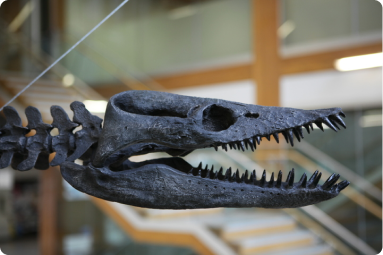
Meet Dorothy, our 80 million year old Elasmosaurs — a 13-metre-long majestic marine reptile who once swam through the Western Interior Seaway of North America. This permanent installation in the Earth Sciences Building was made possible with the generous support of Wheaton Precious Metals.