


NEWS SPOTLIGHT

EOAS remembers Professor Stephen Pond, who passed away on March 23, 2026, and extends our sincere condolences to his family and friends. Steve was a distinguished physical oceanographer and long-time member of the UBC and EOAS community, serving as a professor from 1971 to 1996. He began with the Institute of Oceanography, later the Department of Oceanography, and continued as Professor Emeritus following the merger that formed EOAS. He earned his B.Sc. (Honours, Physics–Mathematics, 1962) and Ph.D. (1965) from UBC.
Over the course of his career, Steve made foundational contributions to physical oceanography, particularly in air–sea interaction and coastal ocean processes. His achievements were recognized with numerous honours, including a UBC Killam Senior Fellowship at Princeton’s Geophysical Fluid Dynamics Laboratory (1987), the Canadian Meteorological and Oceanographic Society President’s Prize (1991), and the Tully Medal (2003). His research significantly advanced understanding of circulation, dynamics, and mixing in British Columbia’s coastal waters. Through long-term observations and innovative numerical modelling, he helped elucidate the complex interactions among wind, runoff, and tidal forcing in systems such as the Strait of Georgia, Knight Inlet, and Sechelt Inlet, laying important groundwork for modern studies of coastal circulation and environmental processes. He was equally well known for his book "Introductory Dynamical Oceanography" written with his friend and mentor, George Pickard, which is still a standard textbook used today.
He will be remembered for his scientific leadership, his dedication to research and education, and his lasting impact on generations of students and colleagues. Our thoughts are with his family, friends, and colleagues during this difficult time.

Congratulations to Dr. Sean Crowe, who has been selected as a recipient of the 2026 UBC Killam Faculty Research Prize in the Sciences and Applied Sciences category.
Established in 1986, the Killam Research Prizes are supported by an endowment created through a bequest from the late Dorothy J. Killam and are awarded annually to ten outstanding researchers at UBC. The Killam Research Prizes are among the university’s most distinguished honors, celebrating faculty across various disciplines who have demonstrated exceptional research excellence, significant scholarly impacts in their fields, and national and/or international research leadership.
Dr. Crowe is a Canada Research Chair in Geomicrobiology and a Professor in the Departments of Earth, Ocean, & Atmospheric Sciences and Microbiology & Immunology at UBC. His work focuses on developing conceptual and numerical models of biogeochemical cycling and the coupled evolution of Earth surface chemistry and life. His interdisciplinary research spans multiple scales of space and time, from mineral-microbe interactions to global processes, and from the Precambrian through to the Anthropocene.
At the Crowe lab, researchers investigate microbiological and geochemical processes in natural and engineered environments to find new solutions for problems in the energy, resource, and health sectors. Their work explores a wide range of questions, including: 1) how did the Earth come to support complex animal life and humans; 2) how will biogeochemical cycles respond to the emergence of humans as geobiological agents; and 3) how can we harness the ingenuity of microbial communities to mitigate pain-points arising from increased human demands on water, energy, mineral, and agricultural resources.

Dr. Curtis Suttle has received the Jacob Biely Research Prize, UBC’s premier award recognizing outstanding research excellence. Established in 1969 and named after eminent UBC researcher and professor Jacob Biely, the prize is awarded annually to a full-time tenure-stream UBC faculty member whose distinguished record of research has shaped their field and contributed substantially to UBC’s standing as a leading research institution.
Dr. Suttle is a professor in the Departments of Earth, Ocean & Atmospheric Sciences, Botany, Microbiology & Immunology, and Institute for the Oceans & Fisheries. His research group studies the role of viruses in the environment, addressing topics such as: 1) the effect of viruses on primary productivity and phytoplankton population dynamics; 2) isolation and characterization of novel aquatic viruses; 3) development of molecular approaches for enumerating and identifying viruses; 4) temporal and spatial distribution of specific viruses; 5) mechanisms regulating viral abundance in nature; and 6) biology, infection processes, and evolution and genetic diversity of viruses. Using approaches ranging from nucleic-acid sequencing to oceanographic sampling, the Suttle Lab examines a diversity of viruses, including but not limited to those infecting prokaryotes, microbial eukaryotes, and marine invertebrates, across environments ranging from the oceans and high Arctic to deep mines, aeolian dust, lakes and migratory-bird ponds.
Dr. Suttle has made significant contributions to the field of marine virology throughout his career. His early work helped redefine scientific understanding of the role of viruses in marine carbon flow through the concept of the “viral shunt” (1999), which was later recognized with the 2021 John H. Martin Award presented by the Association for the Sciences of Limnology and Oceanography (ASLO). Recently, his team has identified pathogens responsible for sea star wasting disease and mass oyster die-offs, advancing understanding of marine disease ecology.
Congratulations, Dr. Suttle!

Dr. Shandin Pete, a Salish and Diné hydrogeologist and Assistant Professor of Teaching in EOAS, studies how Indigenous knowledge systems describe the natural world. Pete has been combining geoscience, ethnography, and community collaboration to reconstruct traditional Salish knowledge that was thought lost to colonization and forced assimilation.
Salish communities and some other indigenous nations view celestial patterns as reflections of another world. The stories these patterns tell are viewed from a bird's eye view, as if the onlooker is watching the happenings of this other world from above, unlike Greek or Roman constellations which are viewed from the side like they’re being displayed in a book. One such pattern represents a gliding canoe using many of the stars within what many recognize as Orion.
Pete’s work brings together archival research, oral traditions, and collaboration with Indigenous knowledge holders to piece together these star traditions. These narratives encode lessons about behaviour, values, community relationships, and the cycles of the natural world while also reflecting careful observation of celestial motion.
By documenting and reconstructing indigenous astronomy, Pete aims to help revitalize knowledge that once guided communities for generations. The research also illustrates how Indigenous knowledge systems hold long records of environmental observation and offer perspectives that complement Western scientific approaches.
Pete’s work highlights the value of Indigenous science traditions and contributes to broader efforts to recognize diverse ways of understanding the Earth and the sky.
In the media
- Vancouver Sun – Salish stories take starring role as First Nation professor examines skies
https://vancouversun.com/news/local-news/salish-stories-first-nation-professor - CBC News – Indigenous astronomer reconstructs Salish sky knowledge
https://www.cbc.ca/news/indigenous/shandin-pete-salish-astronomy-9.7021731 - Radio Canada - Des astérismes autochtones à regarder dans le ciel cet hiver https://ici.radio-canada.ca/nouvelle/2215210/asterismes-autochtones-salish-constellations-traditions
- CBC Video – Indigenous sky stories and Salish astronomy
https://www.cbc.ca/player/play/video/9.7022062 - Museum of Vancouver – Salish Skies: Indigenous Sky Stories with Dr. Shandin Pete
https://www.youtube.com/watch?v=5jklNPNhMNM

Decisions about climate, resources, and environmental risk increasingly shape every profession. Yet many UBC students graduate without learning how the Earth’s atmosphere, ocean, land, and life are interconnected.
A new undergraduate certificate in Earth, Ocean and Atmospheric Sciences aims to change that. EOAS Lecturer Louise Longridge and Professor of Teaching Stuart Sutherland have launched the certificate to expose a broader range of UBC students to the Earth and environmental science topics that shape our world.
Certificates are similar in concept to a minor, but, importantly, the credits earned through a certificate can also apply towards a student’s primary degree. The program focuses on earth system change, with upper-level course requirements (9 credits total) across three core areas: the geosphere, the atmosphere and hydrosphere, and the biosphere.
I spoke with the codirectors to learn more about why they decided to form the program and what it has to offer students.
Why did you decide to form this certificate?
Stuart: It started with something that I considered for a long time - within our department we’re preaching to the choir. Students who are enrolled in our courses are already interested in the environment, environment change, earth history, mass extinctions, and so on.
What we felt was missing was a certificate that students from other disciplines could complete that would appear on their degree and on their CV. This would show that, even if they’re not specializing in EOAS or environmental science, they’ve meaningfully engaged with these ideas.
We wanted to acknowledge that understanding the times we’re living in, and being able to interpret them through the lens of the past, is really important for so many careers. Law, politics, education, really every industry is touched by these issues.
What do you think students don’t realise about studying earth system science?
Louise: I find that as I move through life, I keep returning to concepts I learned about our planet as an undergraduate. Learning about our planet is an opportunity to learn something that you might apply every day. It might really change your worldview in terms of the way you live on the earth and maybe what you want to do with that time.
As I’m looking out the window right now, blinded by the sun, I’m thinking about how extraordinary this planet is. I don’t think I’d have that level of appreciation without those impactful undergraduate courses.
Stuart: I think for the students, this is about being part of the leading edge of understanding the Earth as a system. What's important for them to know is that they aren’t just going to learn isolated facts about dinosaurs, whales, or clouds - this knowledge, is directly relevant to their career and to the entire planet as we move forward.
Louise: We don’t want to catastrophize, but the truth is that everybody is already being affected by climate change in some way. Pretending otherwise isn’t a long-term solution. Instead, we want students to feel empowered by what they learn in the certificate.
Right now, I often hear from undergraduates who feel overwhelmed or discouraged about the future, saying things like, “I can't even look at that. It’s too depressing.” Instead, they’ll leave the certificate with knowledge they can carry forward and use productively. Knowledge is how you get agency. The more you understand, the more capable you are of creating positive change.
Stuart: It's empowering students to make informed decisions and evaluate data critically without drama, fear, or without someone else telling them what conclusions to draw.
Who is the certificate designed for?
Louise: The certificate is intentionally broad to work for students that are not already in Earth or Environmental Science programs. Because of that, it’s honestly beneficial for almost anyone.
Many of the courses don’t have science prerequisites at all For my course, EOSC 326, it’s helpful to have some biology, either from high school or first year, although it doesn’t matter which biology course. Also, most of the courses can be taken any time from second year onward, so students don’t need to wait until later in their degree.
We hope to reach, for example, the second-year arts student who struggled with science in high school and may have written it off. You don’t need to be “a science person”, you just need curiosity about the planet.
What else would you like to say about the certificate to that second year arts student?
Stuart: A lot of the courses in the certificate were originally designed for arts students. I can speak to my course specifically, EOS 310, and there's no heavy math or equation solving involved. The emphasis is on analysis, interpretation, and critical thinking.
Louise: I would want them to know that it doesn't have to be complicated. I think a lot of people picture unfamiliar terminology, or get worried about being unable to read a chart. But these courses are led by people who are very passionate about what they do, and are happy to work with students who are struggling. There are lots of resources available, and help is always there if they need it. Essentially, I’d tell them learning more about the Earth and how it works as a system will likely enrich their life. If they’re interested, just go for it!

(Prepared by Dr. Ali Ameli) Climate variability doesn't affect all watersheds equally—and new research reveals that the difference lies beneath the surface. A study published in Water Resources Research by Mahbod Taherian (Master of Applied Science student in Geological Engineering) and Dr. Ali Ameli (Assistant Professor) at the Department of Earth, Ocean and Atmospheric Sciences shows that year-to-year variations in Fall rainfall fundamentally alter how subsequent snowmelt moves through a watershed—whether it flows quickly to streams, seeps down to recharge groundwater, or returns to the atmosphere through plants.
But the magnitude of this climate-induced shift depends critically on what lies underground. Watersheds with patchy subsurface structure—alternating zones of easy and restricted water flow—route snowmelt very differently depending on how wet the previous Fall was. In contrast, watersheds with uniform underground structure partition snowmelt consistently year after year, regardless of climate conditions in the Fall season prior to snow season. The findings suggest that predicting how water supply and flood risk will respond to climate change requires looking beyond surface characteristics to the hidden architecture below—a factor largely overlooked in current climate change impact assessment studies.
UPCOMING EVENTS
Donate & Give
➔
We extend our heartfelt gratitude to our incredible alumni, friends, industry partners, and research collaborators for their generous support. With your help, the Earth, Ocean & Atmospheric Sciences (EOAS) department at UBC continues to thrive and make a positive impact.
Make a donation today and be a part of the transformative work happening at EOAS. Together, let's build a brighter and more sustainable future for our planet.
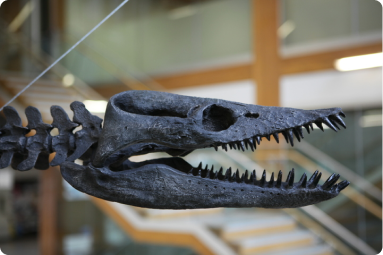
Meet Dorothy, our 80 million year old Elasmosaurs — a 13-metre-long majestic marine reptile who once swam through the Western Interior Seaway of North America. This permanent installation in the Earth Sciences Building was made possible with the generous support of Wheaton Precious Metals.