


NEWS SPOTLIGHT

Read the full UBC Science article here: Researchers identify class of “oddball” meteorite that killed the dinosaurs
Research published in Science Advances earlier this month investigates the mysterious origins of the meteorite responsible for wiping out non-avian dinosaurs 66-million years ago. The international research team included scientists from Université de Paris Cité, University of Vienna, and Vrije Universiteit Brussels, including Dr. Philippe Claeys, who is currently visiting the Pacific Centre for Isotopic and Geochemical Research with Earth, Ocean and Atmospheric Sciences at UBC.
The meteorite belonged to a group known as carbonaceous chondrites – a broad class with diverse elemental properties, leaving the origins of the meteorite largely unknown. Previous studies proposed that the meteorite might have contained high concentrations of sulfur, similar to some meteorites commonly found on Earth. Under this hypothesis, sulfur released during the impact would have played a central role in the severity of the resulting mass extinction.
The researchers dove deeper into the meteorite composition by using advanced nickel-isotope analyses on samples from the thin layer of impact debris deposited around the globe. They found that the meteorite contained little volatile material. Sulphur therefore couldn’t be the expected “smoking gun,” shared Dr. Philippe Claeys. “The fine debris thrown into the atmosphere would have been the primary factor.”
Meteorites with this non-volatile carbonaceous-chondrite composition only make up a tiny fraction of the meteorites ever sampled on earth, not to mention being 10-15 km wide, make it truly exceptional. “Being impacted by such a rare, distant projectile really underscores how unlucky the dinosaurs were,” says Dr. Claeys.
The meteorite’s exact origin remains uncertain. Potential sources including debris from the outer Solar System or the region of the asteroid belt near Jupiter. Studying the composition of the dust the meteorite left behind helps scientist get closer to this answer.

Dr. Shaun Barker, Director of the Mineral Deposit Research Unit (MDRU) and Associate Professor in the Department of Earth, Ocean and Atmospheric Sciences at UBC, is featured in a recent interview with Dr. Brett Davis in Coring Magazine, a quarterly international publication focusing on exploration core drilling.
In the conversation, Dr. Barker reflects on the path that led him into geology, from childhood fascinations with dinosaurs and fossils to formative university field experiences and mentorship that shaped his career. He also discusses his current research interests, including the controls on the formation of copper and gold deposits, mineral system footprints, ore body knowledge, and the development of new technologies in geology. The interview explores the importance of collaboration between academia and industry, the fundamental scientific questions that continue to drive mineral deposit research, and the challenges he has encountered and the solutions he has developed throughout his career. Along the way, Dr. Barker also shares his favorite rocks, dinosaurs, as well as geological discoveries that inspire his enthusiasm for Earth science.
Read the full article here: In conversation with Shaun Barker

Written in collaboration with Gary Fung.
This May, Dr. Maya Kopylova and PhD student Gary Fung from the Department of Earth, Ocean and Atmospheric Sciences (EOAS) went on a two week geological excursion to eastern Paraguay to investigate the origin of alluvial diamonds in the Capiibary area, an Atlantic Forest region in northeastern Paraguay. The fieldwork was strenuous, consisting of trekking through the jungle to reach sites over 40 sites where diamonds had previously been recovered, or to potential diamond source areas in upstream tributaries and floodplains to gather clues on where these stones came from. They sieved and panned stream sediments to retrieve heavy mineral concentrates (e.g., zircon, ilmenite and chromite), and eventually, were rewarded with two ~2mm diamonds found on site. Additional diamond samples were purchased from garimpeiros (artisanal miners) to supplement the research.
Back at UBC, Gary conducts detailed laboratory analyses to reveal the detrital history and provenance of these mysteriously sourced diamonds. By examining their morphology, physical and chemical characteristics, and tiny mineral inclusions trapped during growth deep within the Earth, the research team hopes to identify their source and better understand where in the mantle domain the diamonds originally crystalized. This work, titled “Dual origin of alluvial diamonds from Capiibary, Paraguay”, will be presented at Goldschmidt 2026.

The project was conducted in partnership with the Faculty of Engineering of the National University of Asunción (FIUNA). Maya and Gary delivered lectures and met with faculties and students at FIUNA, sharing information about UBC’s geology and geological engineering programs, as well as the fundamentals of diamond characterization and exploration. Gary thanks his collaborators, Dr. Jaime Presser and Prof. Fernando Larroza, and the project funders at EduCanada and the Geological Society of America for their support. He is grateful to many Paraguayans whose hospitality made the fieldwork possible, and who warmly shared chipa guasu (a traditional dish) during their visit!


Dr. Raymond Andersen, Professor in the Departments of Earth, Ocean and Atmospheric Sciences and Chemistry at UBC, co-led a study recently published in Nature Signal Transduction and Targeted Therapy by researchers at UBC and BC Cancer. The paper has attracted wide attention, with more than 6,700 downloads and a ranking in the top two percent of roughly 240,000 papers of similar age across all scientific fields. It describes a new approach to targeting intrinsically disordered proteins, which have long been considered “undruggable”, marking an early step toward new treatments for prostate cancer and potentially other diseases.
Development of anti-prostate cancer compounds inspired by marine sponges
Prostate cancer accounts for around 20% of new cancer cases in men in Canada, and about one in eight men are expected to be diagnosed with it in their lifetime. The disease is driven by the androgen receptor, a protein that controls gene activity in prostate cancer cells. Most current treatments target the C-terminal structurally stable testosterone-binding domain. But cancer cells are highly adaptable. They can produce mutant forms of the protein that lack this binding domain and contain only the N-terminal disordered region. These variants are linked to castration-resistant metastatic disease, the lethal end stage of prostate cancer.
Over the past two decades, UBC scientists have been working to target this disordered region, which is much more challenging due to its flexible and ever-changing structure – like a moving strand of spaghetti.
A key contribution came from Dr. Andersen’s research in marine chemistry. Since 2003, he has collaborated with Dr. Marianne Sadar, Professor in UBC Medicine and distinguished scientist at BC Cancer, who brought up the idea of developing drugs that bind to the disordered domain of the androgen receptor. Together, their teams screened thousands of extracts from marine sponges collected around the world in Dr. Andersen's lab. These efforts led to the discovery of multiple compounds with entirely new chemical structures that could interfere with androgen receptor activity. "Sponges are amazing," said Dr. Andersen. "Their natural products chemistry is extraordinarily diverse. We've always found novel sponge compounds that show really interesting biology."

A sponge from the Caribbean Sea. Credit: NOAA, Dr. Dwayne Meadows
As with most drug development, the path has not been straightforward. To help move promising compounds toward clinical testing, Dr. Sadar and Dr. Andersen co-founded ESSA Pharma in 2009 (listed on the Nasdaq in 2015 and acquired by XenoTherapeutics in 2025). Their 1st-generation compounds became the first in the world in this field to advance through Phase-1 (toxicity) and -2 (efficacy) clinical trials. However, development was eventually discontinued because the compounds did not have the commercial potential needed to continue. “This is typical in new drug development,” said Dr. Andersen. “Around 95% of companies that take a new compound into clinical trials fail. But we didn't give up there. We decided that since we've got a lead compound, let's see if we can make it better."
Why drugs targeting intrinsically disordered proteins matter
The newly published study reflects nearly 20 years of work to design and test new drugs. This new generation of compounds can bind up to a million times more tightly than any previously reported, while also showing greater stability and no signs of toxicity or off-target effects. In animal models, the compounds remained effective even in the presence of testosterone, raising the possibility that patients treated at early stages might not have to go through castration. Since the compounds target the disordered region of the androgen receptor, they may also help prevent the emergence of the mutant forms associated with the end stage of prostate cancer.
More broadly, this study demonstrates that it is possible to develop drugs against intrinsically disordered proteins—an idea once considered out of reach. The scientists found that their compounds can bind selectively and covalently to the disordered domain of the androgen receptor, locking it into an inactive state. "It's difficult biology to develop a bioassay to screen for these kinds of compounds," said Dr. Andersen. "But it's not an insolvable problem. If you put a bunch of smart people together and they know it can be done, they can start working on all kinds of molecular targets that are intrinsically disordered."
The team is now applying for new funding to investigate how small changes in a compound’s chemical structure can fine-tune the activity of the androgen receptor. One of the study’s most intriguing findings was that the transcriptional activity of the protein could change dramatically when only a single atom in the compound was modified. Understanding why this happens could help researchers design the compound as a chemical tool for regulating transcription.
The intersection of marine science, chemistry, and medicine
Dr. Andersen's lab focuses on the isolation and structural characterization of previously unknown organic metabolites produced by marine organisms. One important direction in their research is bioprospecting: searching marine organisms for chemically unique substances with useful biological activity. This is a form of prospecting with minimal environmental impact. Only a kilogram of sponge material is needed to determine the chemical structure of a compound, and once the structure is known, the compound can be synthesized in the lab.
About half of all medicines either come from natural products or from synthetic compounds inspired by them. The anti-prostate cancer compounds described here are one example. Another compound with life-saving potential developed by Dr. Andersen’s team contributed to the creation of an FDA-approved drug for a rare form of pediatric blood cancer that was once considered fatal.

World’s first review on marine natural products by Dr. John Faulkner and Dr. Raymond Andersen (right) in the book The Sea (left)
When marine chemistry was still an emerging field, Dr. Andersen developed a strong interest in the molecular world within large-scale processes in the ocean. Together with his PhD supervisor, Dr. John Faulkner, he wrote the world’s first review on marine natural products (see photo). Later at UBC, Dr. Andersen and his colleagues published the first paper describing a siderophore in seawater, an iron-binding natural product produced by a dinoflagellate, helping lay the foundation for our current understanding of the role of siderophores in marine metal cycling.
"Natural products are a big part of marine chemistry," said Dr. Andersen. "These molecules are biologically active and they affect the behavior of organisms living in the water. The ocean is a very complex environment, and a fascinating one."
Learn more:
Scientists achieve million-fold leap in targeting elusive cancer proteins
Drugging the intrinsically disordered transactivation domain of androgen receptor
Bridging Oceans and Cultures: Professor Raymond Andersen’s Journey in Science, Discovery and Global Collaboration

EOAS Ph.D. Candidate Cara B. G. James, whose research focuses on the environmental impacts of deep-sea mining, published an article in The Conversation yesterday examining the growing push to mine the deep ocean for critical minerals and the international rules meant to govern it.
The article explains how a recent United States executive order could mean the U.S. will start issuing permits to mine in international waters outside the United Nations framework. It also outlines the criticism this move has drawn from other countries for breaking the UN Convention on the Law of the Sea. Using the case of a Vancouver-based company’s U.S. subsidiary applying for a permit to mine the seabed, Cara considers the potential legal and political implications for Canada, including the significance of the Canadian federal government’s position on deep-sea mining.
Read the full article here: Mining companies may soon bypass UN rules and mine the deep sea

EOSC 328 Field Geology began as usual with “Bootcamp”, a 2-day refresher on campus. Then, the 30 students boarded a bus for the trip to the Oliver region of the Okanagan with geology stops on the way. Once arrived, they settled into their new home for the next three weeks at the UBC –Teck Geological Field Station.
The instructional team this year included faculty (Ken Hickey, James Scoates, Joel Saylor, Matt Tarling) and students (Dylan Spence, Liva Hougaard, Zoe Lynn, Benjamin Johnstone). Our new critical minerals specialist, Cassady Harraden, helped out in the final week as the students started wrapping up their final map area and began focusing on preparation of their compilation maps and cross sections. And Lindsay Nelson, Educational Field & Laboratory Coordinator in EOAS, also joined us for the final week both in the field and at the field station.
The Okanagan weather had a few surprises in store for us this year! During the first two weeks, it was toasty warm (upper 20s, low 30s), but suddenly shifted to cooler temperatures (14-20°C) in the final week, rained continuously on Helipad Ridge day, and even hailed late one afternoon as everyone was walking out.
Spirits remained high throughout the duration of field school (no hammers were lost!), the UBC – Teck Geological Field Station, including the Peter and Maggie Bradshaw Experiential Learning Centre and C. Fipke Foundation Dining Hall, continued to be an impressive venue for teaching and learning, and a newly installed weather station gave us real-time data and forecasting for daily mapping activities.
UPCOMING EVENTS
Donate & Give
➔
We extend our heartfelt gratitude to our incredible alumni, friends, industry partners, and research collaborators for their generous support. With your help, the Earth, Ocean & Atmospheric Sciences (EOAS) department at UBC continues to thrive and make a positive impact.
Make a donation today and be a part of the transformative work happening at EOAS. Together, let's build a brighter and more sustainable future for our planet.
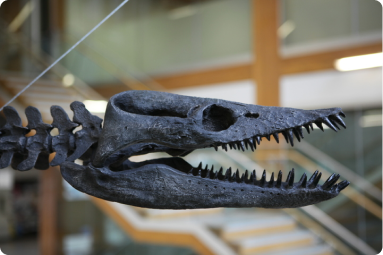
Meet Dorothy, our 80 million year old Elasmosaurs — a 13-metre-long majestic marine reptile who once swam through the Western Interior Seaway of North America. This permanent installation in the Earth Sciences Building was made possible with the generous support of Wheaton Precious Metals.